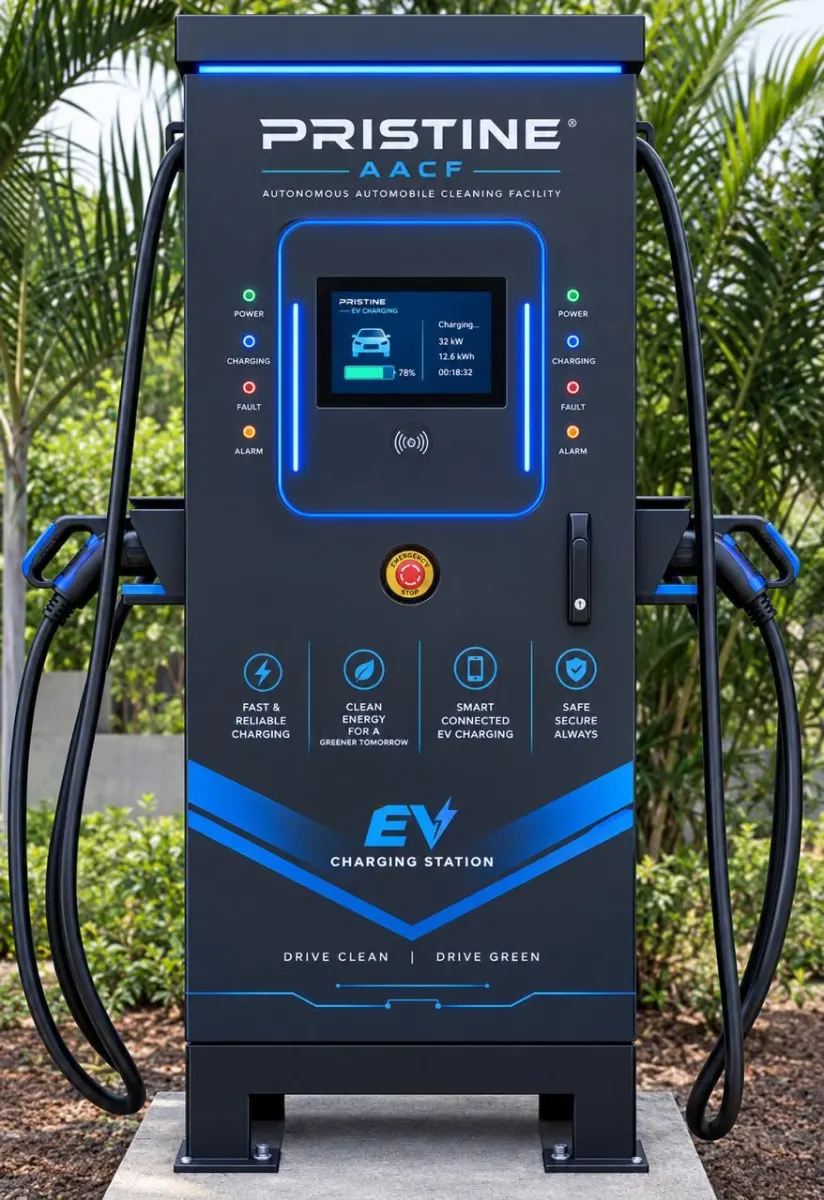
What does a DC fast EV charger cost in India?
+
Pristine AACF quotes every DC fast charger per site, because the total depends on the model, transformer capacity, cable run and civil work. Charger equipment carries 5% GST, and transport and installation are quoted separately. Share your site details and the kW you need, and we send a written site-specific quote covering the charger, installation scope and delivery.
What is a DC charger for EV and how is it different from AC?
+
A DC charger for EV converts mains AC power to DC inside the charger and sends it straight to the car battery, so charging is much faster. An AC charger passes AC power to the car, and the car's small onboard charger converts it, which is slower. Pristine AACF supplies DC fast chargers from 30 kW to 240 kW.
What is a CCS2 charger?
+
A CCS2 charger is a DC fast charger with a Combined Charging System Type 2 connector, the standard DC fast-charging connector for electric cars in India. All Pristine AACF chargers use CCS2 connectors only. Before choosing a model, check that your target vehicles have a CCS2 charging port and note their maximum DC charging power.
What is the total cost to set up a DC fast charging station?
+
Setup cost has four parts: the charger itself, the power connection or transformer upgrade, cabling from the panel to the charger, and civil work such as the plinth, earthing pit and bollards. Pristine AACF quotes the charger and installation per site after reviewing your transformer capacity, cable run and civil scope, so you see every part before ordering.
Does the quoted price include GST, transport and installation?
+
No. Charger equipment carries 5% GST extra. Transport is extra and depends on the delivery location. Installation is quoted separately per site after a review of transformer capacity, cable run and civil work. Payment terms are 80 percent advance and 20 percent on dispatch, with delivery in 2 to 3 weeks from the date of payment.
Is an EV charging station profitable in India?
+
It can be at a high-footfall site. Our estimated example assumes 10 cars a day taking 50 kWh each at ₹26 per kWh plus GST. That is 15,000 kWh a month, about ₹3.9 lakh charging income, and about ₹1.8 lakh gross margin after electricity and maintenance. Your own result depends on footfall, tariff and site costs.
How much can one DC charger earn in a month?
+
Using our estimated example of 10 cars a day at 50 kWh each, a charger sells 15,000 kWh a month. At ₹26 per kWh excluding GST that is about ₹3,90,000 income. After electricity and maintenance of about ₹14 per kWh, the gross margin is about ₹1,80,000 a month. Sites with fewer cars earn proportionally less.
Do I need a licence to run an EV charging station in India?
+
No separate licence is needed. The Ministry of Power EV Charging Guidelines 2024 treat setting up and running a charging station as a de-licensed activity, provided the station follows those guidelines and the relevant technical and safety standards. You still need a suitable electricity connection from your DISCOM and any local building or fire approvals that apply.
How long does the electricity board take to give a connection?
+
Under the Ministry of Power guidelines 2024, DISCOMs should give a charging station connection within 3 days in metro areas, 7 days in other municipal areas, 15 days in rural areas and 30 days in hilly rural areas. Where a mains extension or new substation is needed, the limit is 90 days. Actual timelines vary by DISCOM.
How much electrical load does each charger need?
+
Connected load is the approximate AC supply each model needs: about 34 to 36 kVA for 30 kW, 68 to 72 kVA for 60 kW, 90 to 95 kVA for 80 kW, 135 to 145 kVA for 120 kW, 180 to 190 kVA for 160 kW, 200 to 215 kVA for 180 kW and 270 to 285 kVA for 240 kW, all on 3-phase 415 V AC.
What does my site need before installation?
+
Your site needs a 3-phase 415 V AC supply sized to the model, a proper earthing pit, a parking bay within cable reach with a raised plinth, and a stable internet connection for UPI payments and remote monitoring. A canopy and bollards are optional. Pristine AACF reviews transformer capacity, cable run and civil scope before quoting installation.
Which kW charger should I choose for my site?
+
Match the charger to how long vehicles stay. Hotels, hospitals and small depots where cars park for hours suit 30 kW. Malls and city hubs suit 60 kW. Highway stops and fuel plazas suit 80 to 120 kW. Expressways, bus stops and heavy fleet terminals suit 160 to 240 kW. Your available electrical load also limits the choice.
What is the difference between single-gun and dual-gun chargers?
+
A single-gun charger, like the 30 kW model, has one CCS2 connector and charges one vehicle at a time. Dual-gun models from 60 kW to 240 kW have two CCS2 connectors and share power dynamically, so two vehicles can charge together and the available power is split between them. Dual-gun units serve more cars per bay.
Which cars can use these chargers?
+
All Pristine AACF DC fast chargers use CCS2 connectors, the standard DC fast-charging connector for electric cars in India, also used on electric buses. The output range of 150 to 1000 V DC covers both lower-voltage and newer high-voltage battery platforms. Check your target vehicles' charging port and maximum DC charging power when choosing a model.
How do drivers pay at the charger?
+
Drivers scan the UPI QR code on the charger, pay with any UPI app such as PhonePe, Google Pay or Paytm, and charging starts automatically after payment. There is no app to download, no account and no wallet top-up. Pristine AACF configures UPI collection for your business, and payments settle to your bank account.
Do drivers need to install an app to charge?
+
No. Drivers only scan the UPI QR code on the charger and pay with the UPI app already on their phone. There is nothing to download, sign up for or top up. This removes the most common reason drivers abandon a charging session, and it means the station owner does not need to run a separate customer app.
When does the charging money reach my bank account?
+
UPI collections settle directly to your business bank account. Settlement timing, and any payment-gateway or UPI processing charges, depend on the payment partner and your agreement with them. Pristine AACF configures UPI collection for your business during setup, so you can see payments arriving without handling cash or driver accounts.
What is OCPP and why does it matter?
+
OCPP is the open communication standard between a charger and its management software. Pristine AACF chargers support OCPP 1.6J and 2.0.1, so they can connect to payment and remote monitoring systems and to standard charge-management platforms. Using an open standard avoids being locked into one software provider if you later change platforms or add chargers.
Are there government subsidies for EV charging stations?
+
Some states offer capital subsidies, paid after the station starts operating. Tamil Nadu offers 25% up to ₹10 lakh for public fast stations with at least 3 chargers and 50 kW load. Karnataka offers 25% up to ₹10 lakh. Uttar Pradesh offers 20% up to ₹10 lakh for stations investing ₹25 lakh or more. PM E-DRIVE runs through government bodies. Approval is never guaranteed.
Can a private business get PM E-DRIVE charging subsidy?
+
Not directly. Under the PM E-DRIVE operational guidelines, only ministries, central public sector companies and state nodal agencies submit proposals. A private site owner or operator can take part only by winning a bid from one of those bodies. Car DC chargers must be 50 to 250 kW CCS2, so a 30 kW charger is outside the scheme.
What is the Tamil Nadu subsidy for charging stations?
+
The Tamil Nadu EV Policy 2023 offers eligible public fast charging stations 25% of equipment and machinery cost, capped at ₹10 lakh per station, for the first 200 public fast stations. A public station needs at least 3 chargers and 50 kW active load. The station owner claims it after operations start, and Pristine AACF does not guarantee approval.
What GST applies to chargers and to charging?
+
Two different rates apply. GST on the charger equipment itself is 5%, which Pristine AACF adds to the equipment invoice. GST on the charging service a station bills to drivers is 18%. So when a station sells charging at ₹26 per kWh, GST is added on top for the driver, and the station remits it to the government.
How long does delivery take after ordering?
+
Delivery takes 2 to 3 weeks from the date of payment. Payment terms are 80 percent advance and 20 percent on dispatch. Because delivery is quick, start your electricity connection, earthing, plinth and internet before ordering so the charger can be installed and commissioned soon after it arrives. Installation time depends on your site's readiness.
What warranty and service do the chargers come with?
+
Warranty is as per the manufacturer's terms, which are set out in your written quotation. The chargers use SiC modular rectifiers with N+1 redundancy, so a single module fault need not stop charging, and OCPP connectivity allows remote monitoring. Confirm service coverage, response times and spares for your location in the quotation before ordering.
Can the chargers run outdoors in Indian heat and rain?
+
Yes. All models are IP54 and IK10 outdoor rated, meaning they resist dust, water spray and physical impact. They have a 10-inch sunlight-readable touchscreen for bright daylight. For best reliability and driver comfort, many sites still add a canopy over the bay, which also protects drivers from rain while they plug in and pay.
Can a hotel or mall earn from EV chargers?
+
Yes, in two ways. The charger earns directly from every kWh sold through UPI payments, and it brings EV drivers who spend time and money on site while their car charges. Hotels usually suit a 30 kW charger for longer stays, while malls suit 60 kW for shorter visits. Earnings depend on how many EVs visit.
Does Pristine AACF supply chargers outside Tamil Nadu?
+
Yes. Pristine AACF supplies commercial DC fast chargers across all of India. Transport is charged extra depending on the delivery location, and installation is quoted per site. Call or WhatsApp 77089 94055, or 88070 22133, with your city, site type and the kW you need, and we will send a site-specific quote and delivery timeline.
Who sets the price per kWh that drivers pay?
+
The station owner sets the price drivers pay, within applicable government rules. The Ministry of Power guidelines set a ceiling on the service charge for public fast charging until March 2028, and 18% GST is added for drivers. Our estimated example uses ₹26 per kWh plus GST; confirm the right price for your state before launch.